
EXPANDED
MEMORY
A multimodal cognitive workspace engineered to mitigate interaction fatigue. Designed to index personal data clusters via low-latency voice intent pipelines, utilizing subtle spatial micro-gestures for fluid contextual manipulation across a continuous semantic memory layer.
Tech Lab
Expanded Memory
Concept / Interaction Design Study
- Role
- Creative Director & Technologist
- Year
- 2025
- Client
- Tech Lab
- Discipline
- Tech Lab
PROJECT OVERVIEW
A multimodal cognitive architecture inspired by cinematic computing, engineered to overcome the physical limits of spatial interaction. By shifting heavy input to voice-driven intent and reserving spatial micro-gestures for fluid data manipulation, the system establishes a zero-fatigue environment for human-computer collaboration.
Expanded Memory is a modern response to interactive sci-fi interfaces—from Minority Report's gestural fantasy to today's ambient stack of XR glasses, on-device hand tracking, and advanced LLMs. Where early motion sensors demanded exhausting, full-arm choreography, contemporary tooling makes spatial cognition a practical design medium rather than a demo novelty.
The Ergonomics of Free Space
Voice Cognition.
Low-latency bidirectional voice pipelines streaming natural language directly into localized memory clusters for intent-driven interaction.
Spatial Gestures.
Camera-mapped gesture tracking translates cinematic interface theory into raw frontend inputs across the spatial data plane.
Cognitive Core.
A semantic vector engine continuously indexes, clusters, and surfaces cross-references from your personal data ecosystem.
The core challenge in free-space interaction is well documented in HCI as Gorilla Arm Syndrome—the physical exhaustion caused by prolonged, high-effort gestures held away from the body. The design problem is precise: how do we preserve the cinematic impact of spatial UI without fatiguing the user within minutes?
Expanded Memory reframes spatial input as a complement to voice, not a replacement. Abstract commands migrate to speech; the hands remain available for precise, low-amplitude manipulation—keeping the interaction loop sustainable for extended work sessions.
The Multimodal Solution
The architecture splits intent across two parallel channels. Voice is designed as the channel for abstract commands—natural language mapped into structured semantic actions—so the user never has to hold a pose to issue intent.
Hand tracking is reserved for micro-gestures only—subtle pinch, flick, and scroll bounds executable with an elbow resting on a desk. This division of labor keeps spatial interaction expressive while dramatically reducing the physical cost of continuous use.
The Lightweight Browser Sandbox
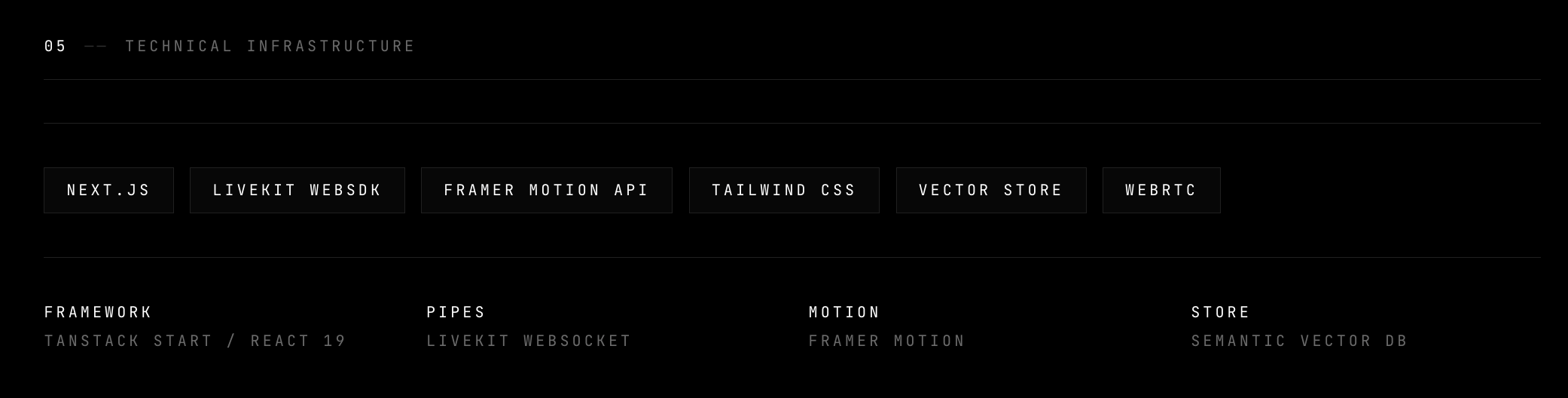
The engineering outcome is a high-fidelity, client-side spatial interaction sandbox—built on a modern Vite-driven, React 19 architecture with seamless, performance-optimized local processing pipelines.
The case study presents the interaction model as a browser-native concept study: gesture bounds, spatial UI motion, and multimodal flow designed and mocked for portfolio review rather than as a shipped realtime product stack.
Demonstrated a zero-fatigue multimodal loop: voice for intent, micro-gestures for manipulation
Prototyped a browser-native spatial sandbox with cinematic UI motion and 60fps interaction targets
Established a reusable interaction design system for cinematic computing in real product contexts